Earth architecture as a model for the building of tomorrow
In northern China, the traditional Dikengyuan construction method shows how extreme climatic conditions can be compensated for with the simplest of means. Hole-in-the ground houses cut deep into the loess soil have been creating comfortable interiors for thousands of years. Without heating, without cooling and with minimal use of resources.
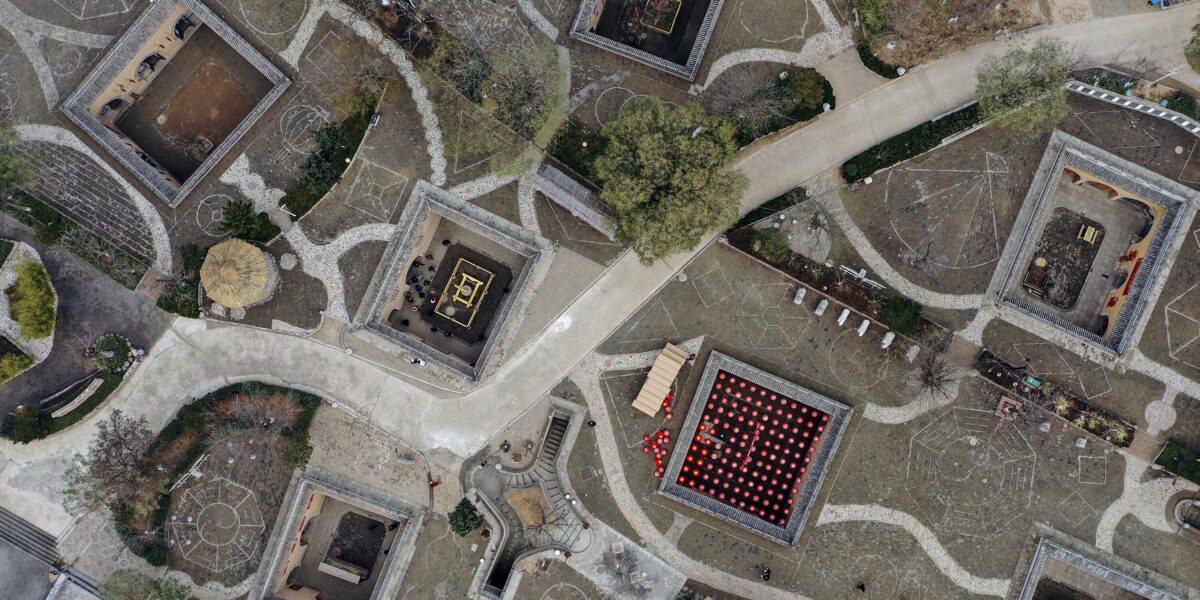
Foto: picture alliance / Xinhua News Agency | Tao Ming
The pit and cave dwellings in the Chinese Loess Plateau date back to Neolithic settlements and are considered a living fossil of the history of residential construction. Despite the limited lifespan of individual buildings, the principle of the dug-in courtyard house has been preserved for thousands of years and shaped the lives of millions of people.
Historically, the underground courtyard complexes were mainly used by the rural population, but later political figures such as Mao Zedong and Xi Jinping also lived in such cave houses for a time. The settlement structures range from individual courtyards to almost invisible, interconnected underground village networks.
Loess as a building material and building physics carrier
Load-bearing, yet easily workable loess soil forms the basis of this architecture. Living and ancillary rooms are cut directly into the natural soil, usually without elaborate supporting structures or industrially produced building materials. The construction costs are significantly lower than those of conventional houses.
The central pit courtyard, up to ten meters deep and eight to twelve meters on a side, provides access, light and ventilation at the same time. The courtyard level is reached via ramps or stairs, while drainage pits collect rainwater and prevent flooding.
Thermal inertia as a climate machine
The strength of the Dikengyuan lies in the consistent use of the thermal inertia of the earth mass. In summer, the earth cover keeps the heat out and stabilizes the interior temperature at around 14 degrees Celsius, while in winter the stored geothermal energy acts as a buffer against low outside temperatures.
In this way, the houses function as largely passive climate systems that do not require heating or air conditioning. The construction method is therefore not a folkloristic relic, but an early, highly effective model for energy-efficient construction adapted to the local climate.
Inspiration for energy-efficient architecture today
The Dikengyuan opens up important approaches for managers and experts in planning and the real estate industry. Local materials, reduced technology, robust building physics and the integration of buildings into the ground as a climate envelope. In the face of net-zero targets and resource scarcity, they show what resilient, cost-effective forms of housing can look like beyond highly complex building technology.
The challenge is to translate these principles into contemporary typologies, standards and construction processes, from partially buried buildings to hybrid solutions in dense urban contexts. In this way, millennia-old earth architecture becomes a laboratory for future-oriented, climate-resilient construction.