Efficient cooling with underfloor heating
Underfloor heating can do more than just heat. In combination with a suitable heat pump, it becomes a quiet, efficient and environmentally friendly cooling solution in summer. The article shows how active and passive systems work, where their limits lie and what is important when planning.
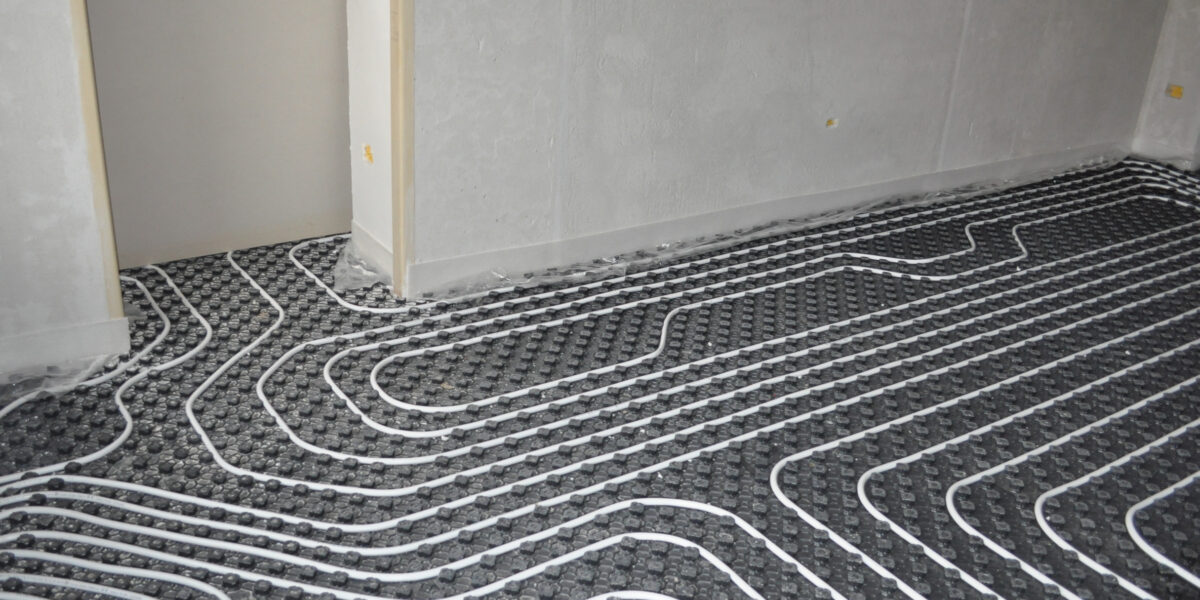
In well-insulated new buildings and energy-efficiently renovated old buildings, interest in alternative cooling methods is increasing. Underfloor heating can not only provide cozy warmth in winter, but can also contribute to a pleasant indoor climate in summer, provided it is connected to a suitable heat pump. This opens up an efficient, noiseless and climate-friendly dual use of existing technology.
Technology that can do both
Only water-based systems are suitable for cooling. Cool water flows through the pipe system laid in the floor in summer, controlled by a pump and a smart control system. The decisive factor is the combination with a reversible heat pump, which provides technical support for the cooling mode. The difference between heating and cooling mode lies primarily in the water temperature. Instead of 35 to 40 °C, 16 to 20 °C is pumped through the system.
Active or passive – two ways to cool down
Passive cooling uses the temperature difference to the ground or groundwater without the compressor being active. This saves energy, but is often only sufficient for a slight temperature reduction in very hot weather.
Active cooling, on the other hand, works at full pump capacity. Rooms can be cooled significantly more, but with higher power consumption.
Brine/water and water/water heat pumps are suitable for both variants. Air/water systems are designed exclusively for active cooling.
Technology and planning must go together
The achievable temperature reduction is between 2 and 5 °C. With active solutions, values around 20 to 22 °C are also realistic. A flow temperature that is too low can cause condensation. This is why systems with dew point monitoring are needed that automatically counteract critical values.
Know the limits, exploit the potential
Underfloor heating systems react slowly, so cooling needs proactive control. However, with good planning and suitable technology, anyone building or renovating today can rely on a single system that provides year-round comfort without additional air conditioning.
The achievable temperature reduction depends on the construction method, insulation and design of the system. In well-insulated new buildings or renovated properties, it is possible to cool rooms to 22 °C or below even when it is hot outside. Bedrooms, offices or heavily heated living areas in particular benefit from uniform, silent cooling.