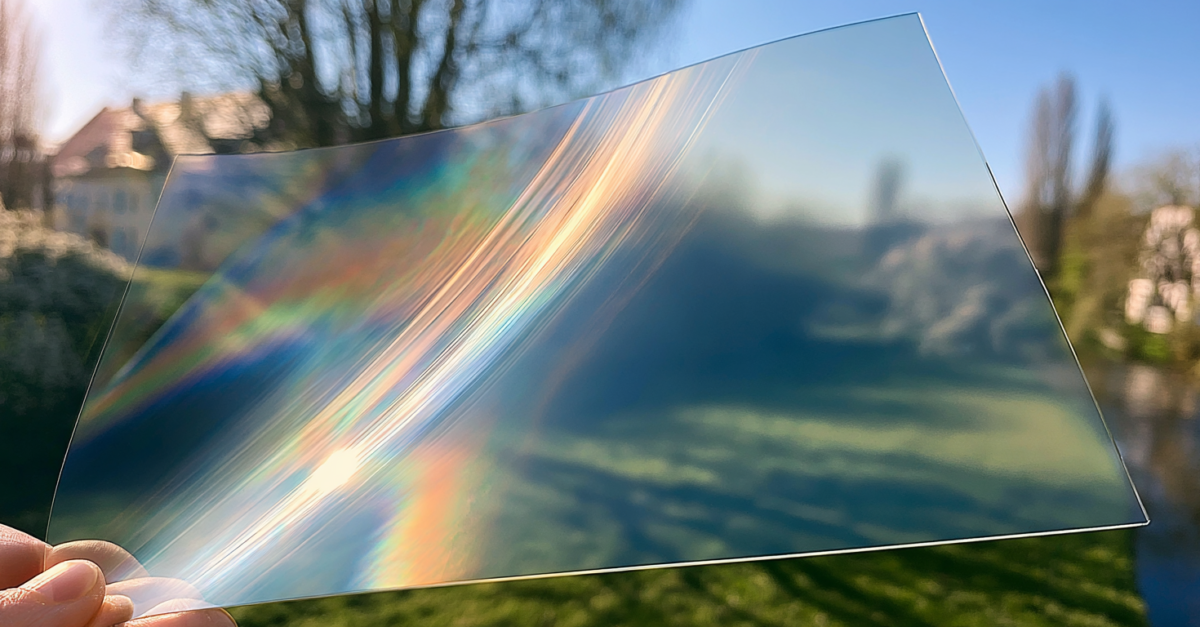

Photovoltaics installed on building facades, greenhouses, or vehicle roofs face a conflict of objectives. The more light a module transmits, the less light remains for electricity generation. This is precisely where organic photovoltaics come into play. They can be designed flexibly and allow some visible light to pass through while generating energy.
Researchers at the University of Freiburg and Fraunhofer ISE have now fabricated a semitransparent organic module with an area of 210.25 square centimeters. It achieves an average light transmittance of 43.2 percent in the visible spectrum and an efficiency of up to 9.26 percent. The light utilization efficiency is up to 4.0 percent.
The Major Breakthrough
This advancement is less of a laboratory achievement and more a demonstration of manufacturability. The modules measure 14.5 by 14.5 centimeters. Their layers were produced using sputtering and slot-die coating. Both processes are well-established in the industry and can be scaled up to larger areas.
This is crucial, as many solar cells deliver strong performance on small laboratory-scale surfaces but lose their efficiency when scaled up to larger modules. The Fribourg team succeeded in transferring the coating of the cell layers to the module surface using the scalable slot-die process with virtually no significant losses. The results were published in early August in the journal *Joule*.
Architecture Gains a New Option
The technology does not replace silicon modules. Its potential lies in applications where surfaces must simultaneously allow for light, visibility, and design. With transparency well over 50 percent, such modules could be integrated into glass facades and greenhouses in the future. For tinted components such as vehicle roofs or certain facade elements, lower light transmittance may even be desirable.
This shifts the focus for project developers and architects. It is no longer just a question of whether there is enough space on the roof for solar power. Rather, it is about which building components themselves can become part of energy generation.
Film as the Next Level
Slot-die coating is also compatible with roll-to-roll processes. This opens up possibilities for PV on film and, consequently, for lighter, flexible applications. The project has already produced flexible modules that fully retained their original efficiency after 1,275 bending cycles over a rod with a diameter of 15 millimeters.
The path to large-scale, transparent power generation remains challenging. But the direction is clear. When industrial processes, design, and energy production come together, the building envelope transforms from a cost factor into active infrastructure.