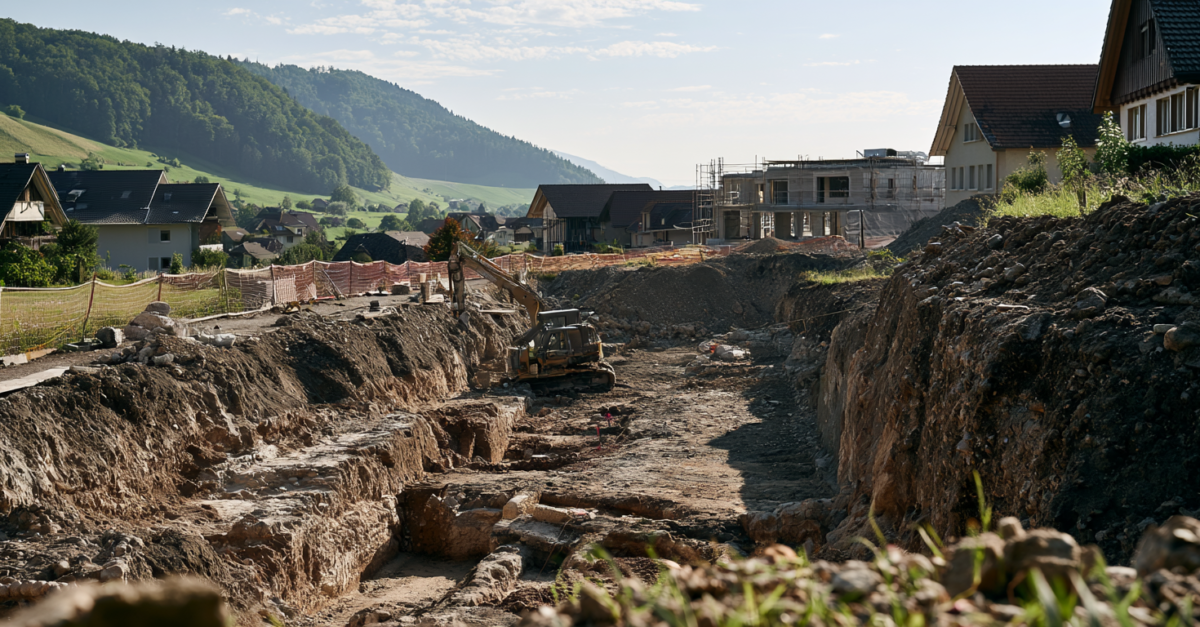

On Dürrenäscherstrasse in Teufenthal, new development meets ancient history. While the residential project—following years of legal disputes—wasn’t officially launched until June 3, 2026, the construction site has since had to be secured for archaeological investigations. However, according to the municipality, there is no formal construction halt in place.
This shifts the focus to the practical aspects of construction. On the site, which will feature 67 residential units, a pit containing pottery shards and a fragment of a bronze ornament was discovered. The finds are dated to the Late Bronze Age, roughly between 1300 and 1200 B.C. For the project, this does not mean a complete legal halt, but rather a temporary suspension of certain work until the cantonal archaeology department has documented the findings.
Project Slowed Down Again After a Long Legal Process
The project had already been significantly delayed before construction began. According to project information, the legal dispute dragged on for several years. In January 2026, the developer announced that, following the resolution of objections, 67 units would be built. The plans include apartments, townhouses, and compact homes. The official groundbreaking was announced on June 3, 2026, and according to project communications, occupancy is scheduled for the end of 2027.
For developers and municipalities, this case illustrates just how significantly schedules can still change even after construction has been approved. Archaeological finds are not merely a footnote; they can necessitate last-minute adjustments to excavation, preservation, and documentation. Especially in valley locations with deep-lying older strata, this risk remains a reality in civil engineering projects, even if no spectacular archaeological site was previously known to exist.
Not a second Troy, but a significant discovery
According to cantonal data, Aargau has more than 3,700 documented archaeological sites. Bronze Age sites are well-documented in the canton, even though Teufenthal has hardly been of archaeological interest until now. This makes the current discovery all the more relevant to the construction site itself. It does not alter the building permit, but it directly impacts the construction schedule and highlights that even a locally rooted residential project can encounter unexpected obstacles during the execution phase.
It remains to be seen how significantly this interruption will affect the rest of the schedule. The key factors will be how quickly the archaeological documentation can be completed and which areas of the site may need to be re-examined.