

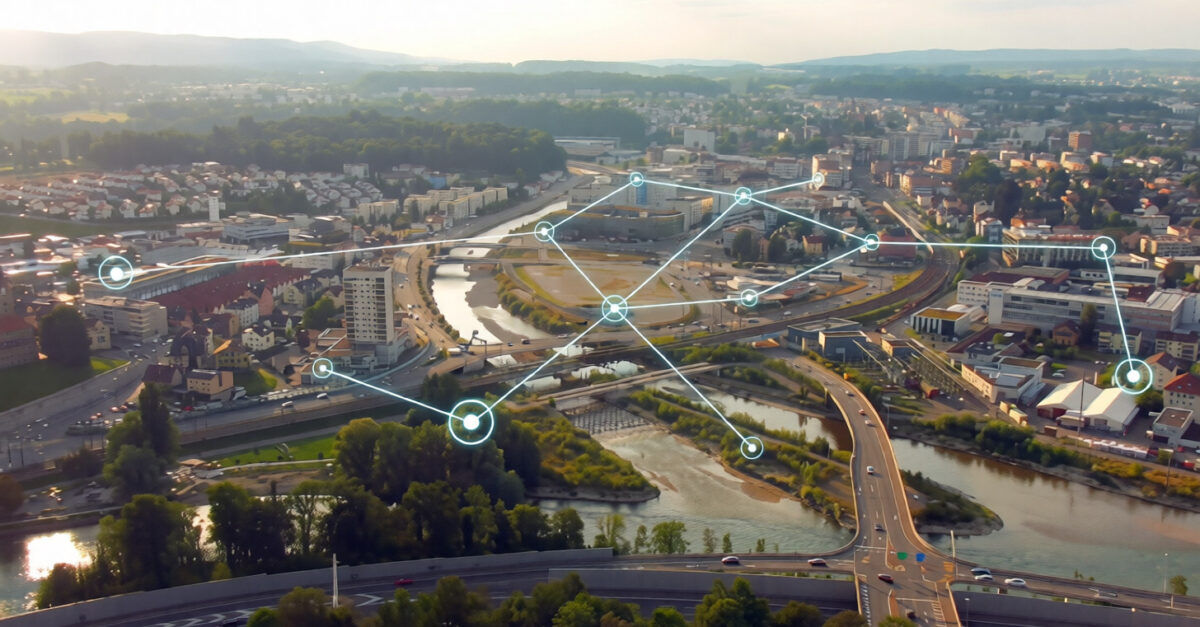
Here, ‘Smart City’ does not mean technology for technology’s sake. What matters is whether the area makes everyday life easier, more climate-friendly and more liveable. Buses, trains, cycling, energy, public spaces and digital services must all work together. People are at the heart of it – not just the infrastructure.
A neighbourhood emerges from the floods
The once-in-a-century floods of 2005 hit the area at the confluence of the Reuss and Kleine Emme hard. The subsequent flood defences did more than just protect the riverine areas; they presented an opportunity to rethink the area. With the Reusszopf and the Nordpol, new recreational spaces were created along the water’s edge.
Today, LuzernNord is developing as a key focus for cantonal development. Seetalplatz, Seetalstrasse, Viscosistadt, Emmenbrücke railway station and Littauerboden form a cohesive development area. The aim is to create a modern, environmentally focused centre by the river.
New buildings bring everyday life
The cantonal administration building on Seetalplatz will bring around 2,000 jobs to the area. The relocation of cantonal offices from Buobenmatt is scheduled to be completed by the end of March 2027. This will increase the demand for catering, shopping, safe routes and efficient public transport.
The new development demonstrates how public infrastructure can generate fresh momentum. The hybrid building, constructed using Lucerne State Timber, is aiming for SNBS Gold and Minergie-P-ECO certification. Alongside offices, the development will include flats, commercial premises, a restaurant and a police station. The building will thus become part of a densifying neighbourhood.
Construction of Rüüssegg on the banks of the Kleine Emme is set to begin in autumn 2026. By the end of 2029, 344 flats and around 1,700 square metres of office and commercial space will have been completed. The mix of rental flats, owner-occupied properties and co-operative housing gives the neighbourhood social diversity. Communal spaces and outdoor areas designed to blend with nature connect the buildings with the riverside.
The ‘Metropool’ project by Luzerner Kantonalbank is also gaining momentum. Following a legal hold-up, the first phase of construction will begin in autumn 2026. Occupation is scheduled for 2030. Seetalplatz will thus gain another landmark location for workplaces, services and urban life.
Mobility will be the litmus test
LuzernNord can only work if increasing density does not lead to more car traffic. Emmenbrücke railway station and the Seetalplatz bus hub form the basis for this. The forecourt at the South bus station is being refurbished. New cycle parking spaces, trees and leisure areas will improve the interchange experience.
The 4Viertel project already demonstrates how mobility can be organised differently. A mobility station brings together electric cars, cargo bikes, scooters and bicycles. Vehicles can be reserved, unlocked and paid for via an app. Residents will receive a mobility package with offers for public transport and car-sharing.
Buses, trains, bikes, walking and shared vehicles must be at least as convenient in everyday life as one’s own car. The Canton of Lucerne, the municipality of Emmen and LuzernPlus are therefore working together to enhance and improve walking and cycling at Seetalplatz. In addition, in collaboration with the Lucerne Transport Association, a holistic concept for housing, transport and quality of life is being developed along Seetalstrasse.
Energy connects neighbourhoods
The ‘Viscosistadt’ project demonstrates how energy can be organised at neighbourhood level. The Seetalplatz heating network uses energy from the groundwater of the Kleine Emme and waste heat from Monosuisse AG’s industrial production for heating and cooling. The pumps are partly powered by solar electricity generated on the roofs of the site.
The city is built together
A Smart City is not created solely in planning offices. Lucerne North successfully trialled a participatory neighbourhood budget through the ‘Quartiereffekt’ initiative. A total of 21,000 Swiss francs was made available for ideas from the local community. Further projects designed to promote participation and foster a sense of identity – particularly in collaboration with the various stakeholders based in the LuzernNord area, such as the HSLU – are already in the planning stage. The message is clear: those who live and work here should be part of the development and help shape their living environment.
The smart city is taking shape
More Articles
Upper Valais is falling behind in the home ownership race
In Valais, house prices continue to rise, even though the market is cooling in some regions. In the Upper Valais in particular, buying a home remains out of reach for…
Oerlikon’s sports centre project has been delayed by a year
In Zurich-Oerlikon, the start of construction on the new sports centre has been postponed until the second quarter of 2028. This means the main building will not open until 2032…
Intershop Shows How Data Aggregation Becomes a Business Model
The real estate company Intershop is selling its fully developed Lehenmatt developments in Basel to a Swiss investment foundation. Prior to the sale, 264 apartments underwent energy-efficiency renovations, and 68…
When Lucerne turns its façades green
With GreenBrick, Lucerne University of Applied Sciences and Arts is developing a façade designed to cool buildings in summer whilst also promoting greening in densely built-up areas. The system combines…
 immo!nvest+
Fewer building codes are expected to lead to more housing
The housing shortage in Switzerland calls for new solutions. In its latest real estate market study, Raiffeisen proposes so-called “White Zones.” Temporary relaxations of building codes are intended to accelerate…