View into the fire zone
The FireDrone flies into burning buildings, tunnels or industrial plants and delivers real-time data from extreme environments. Developed at Empa and continued as a spin-off, it combines heat-resistant materials with intelligent robotics for greater safety and efficiency in firefighting and industrial operations.
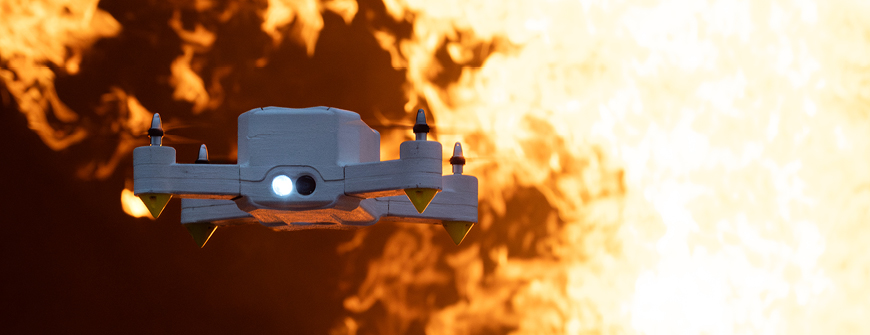
FireDrone in action in high-temperature and fire environments. Photo: Empa
Fires in large buildings, tunnels or industrial plants are a race against time. Emergency services often have to venture into smoke-filled, unstable structures without knowing exactly what to expect. The FireDrone is designed to close this gap and, as a heat-resistant reconnaissance platform, flies into hazardous areas and delivers situation information to the screen in real time.
Instead of sending people into areas at risk of collapse, the flying robot takes over the reconnaissance. It detects hazardous substances, helps to locate missing persons and shows sources of fire where visibility and access are limited. This reduces the risk for emergency services and increases the quality of decisions.
Greater safety for fire departments and industry
Toxic smoke, collapsing components and explosions are among the greatest risks in fire operations. Searching complex structures such as multi-storey parking lots, industrial halls or tunnels is particularly difficult and dangerous. This is where the drone comes into its own, as it can fly over such areas quickly and precisely without causing any damage.
The heat-resistant drone also opens up new options in industry. Today, plants with furnaces, refineries or thermal processes often have to be shut down for hours or days before an inspection is possible. The drone should be able to inspect cement or steel plants as well as waste incineration plants during operation. This shortens downtimes, reduces costs and saves energy.
Aerogel shell for 200 degrees
Where conventional drones fail at around 40 degrees Celsius, this one stays in the air. Its core is a patented insulation made of ultra-light aerogel. This material consists almost entirely of air, embedded in a heat-resistant polyimide structure, and protects the sensitive electronics from temperatures of up to 200 degrees Celsius.
The new generation dispenses with complex composite structures with glass fibers and relies on a pure polyimide aerogel that can be cast into three-dimensional shapes. This means that the shell is practically cast in one piece and fits snugly around the components.
The new aerogel variant combines high heat resistance with mechanical flexibility and is supplemented by an internal temperature management system that actively monitors and cools the electronics.
Thermal images in real time even without GPS
When in use, the drone delivers high-resolution thermal images directly to the remote control. An infrared camera makes sources of fire, heat pockets or hidden people visible, even through thick smoke. Several emergency crews can follow the images at the same time and thus get a picture of the situation independently of the first team in the building.
The drone can be modularly equipped with additional cameras or sensors. It can also measure outside temperatures or detect gases produced by fires. Another highlight is its use indoors. As GPS often fails in buildings, tunnels or covered industrial facilities, the system works with specially developed assistance and localization functions that ensure stable flights even without a satellite signal.
From laboratory to operational vehicle
The path from prototype to operational solution leads through tests under real conditions. The drone has already been tested on training grounds for firefighters and in operating industrial plants, including the Siggenthal cement works. The aim is for pilots to be able to use the drone safely in extreme situations after minimal training.
With the planned FireDrone Nest, the spin-off is going one step further. The mobile, thermally insulated docking and maintenance station is to be integrated into fire engines or modern fire protection systems. After a mission, the drone lands automatically, is secured, checked and prepared for the next flight. This turns a research project into a reliable system for everyday use by fire departments and industry.
Spin-off with a tailwind
The drone represents a line of development that began in the Empa laboratories for “Sustainability Robotics” and “Building Energy Materials and Components”. Today, a spin-off from Empa and EPFL is driving the technology towards market application. The team is supported by various funding programs and foundations that enable the transition from idea to product.
For the researchers, it is clear that the combination of new material technology, robotics and practical testing opens up a new chapter in firefighting. The task now is to take the drone from the test environment to real operations so that in future it can fly to places where it is better for people to keep their distance.