

The 2009 structural plan, which remains in force, set out the objective of concentrating the future economic development of the canton of Lucerne in the most attractive transport locations: This laid the foundations for the cantonal development priorities (ESP) – areas with high potential in conveniently located sites. A prerequisite for the further development of the ESPs is the optimisation of transport links: for it is only where sites can be accessed quickly and easily from various directions that businesses can establish themselves and operate successfully in the long term. This also applies to public transport: alongside the expansion of roads, the Canton of Lucerne is placing a strong emphasis on sustainable mobility, not least in order to meet its climate policy targets.
The cantonal development priorities form the central link between business promotion and spatial planning. They are further developed in collaboration between the canton, regions and municipalities. Economic Development Lucerne is also committed to the forward-looking further development of the ESP. The shared objective is for all development priorities to be characterised by available, attractive sites with a specific marketing profile. The area management team for each development priority establishes its framework in collaboration with landowners and investors.
In addition to the cantonal development priorities, the Structural Plan defines three strategic working areas (SAG). These are contiguous, larger sites ranging in size from 10 to 30 hectares. Clear criteria have been laid down for the use of these areas: they are reserved exclusively for businesses that generate particularly high added value, as well as for property development projects. The development of the SAGs takes place in close coordination between the Canton of Lucerne, the relevant municipality and the Lucerne Economic Development Agency.
Commercial land in the Lucerne urban region
ESP Lucerne East
The ESP Lucerne East comprises the three sub-areas of Rontal, Perlen and Schachen. Around 31,000 people live here, whilst a further 19,500 work here. Strategically situated on the Lucerne–Zug–Zurich axis, the region is optimally connected to key economic centres. It is a forward-looking area, dynamic and with great potential. The transformation is in full swing: over the next few years, some 9,000 new homes and around 6,000 jobs will be created here in stages.
ESP LuzernSüd
Urban, creative, sustainable: LuzernSüd is nestled between the Sonnenberg, the Biregghügel and the Horw Peninsula at the foot of Mount Pilatus. The area encompasses parts of the municipalities of Kriens, Horw and Lucerne. Over the next 20 years, homes and jobs for 10,000 to 15,000 people will be created in stages in this diverse residential area. Lucerne South is well connected by all modes of transport and is generating enthusiasm with its urban quality and the ‘Freigleis’ cycle highway.
ESP Lucerne Station
The ESP Lucerne railway station is both a key tourist destination and a regionally significant transport hub. It is situated entirely within the city of Lucerne. Its development goes hand in hand with that of Lucerne’s through station. The area around the station will take on a new character thanks to unique urban development opportunities. Several buildings have already been completed in the Rösslimatt area, including those housing the two anchor tenants: the Lucerne University of Applied Sciences and Arts and the international pharmaceutical company MSD.
ESP Lucerne North
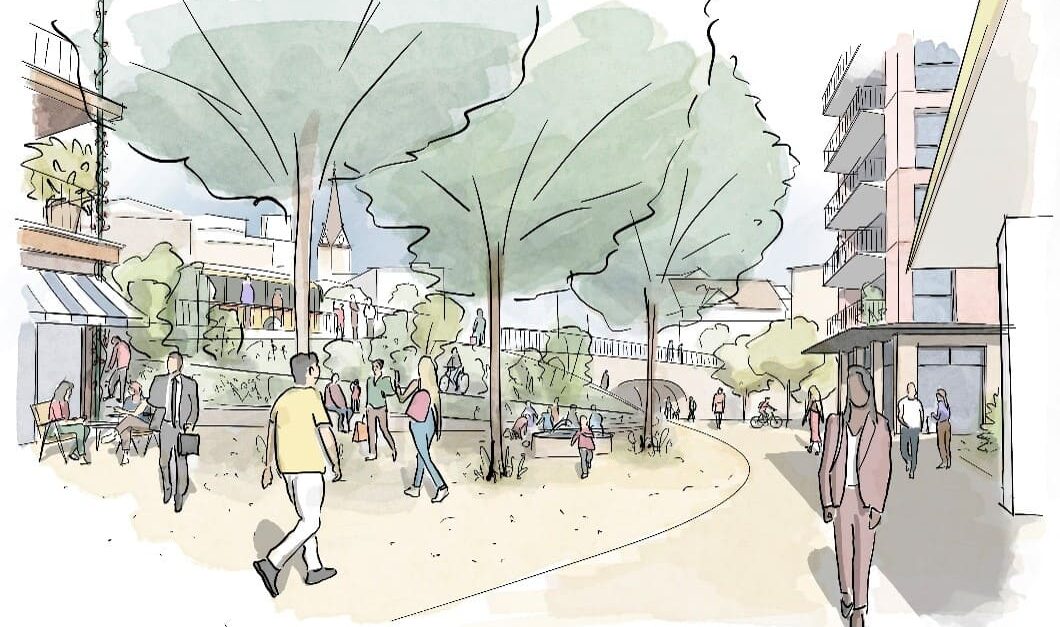
Lucerne North comprises the sub-areas of Seetalplatz, Seetalstrasse, Littauerboden and Ibach. The Lucerne North district, situated within the municipal boundaries of Emmen and Lucerne, was designed as a Smart City. Here, people live and work in a modern, eco-friendly and vibrant centre right on the banks of the Kleine Emme and the Reuss. Over the coming years, 1,500 new flats, 4,000 additional jobs and 850 study places at Lucerne University of Applied Sciences and Arts will be created here in stages. The Canton of Lucerne will also be moving into its new central administrative building here in the coming months.
ESP Rothenburg Station
With its attractive location on the northern edge of the Lucerne urban region and the recently expanded Rothenburg Station, this ESP enjoys excellent transport links and is developing into a modern and sustainable employment area. It is a hub of opportunity which is gaining further momentum through partnership-based collaboration as part of the ESP’s development.
Sursee, Seetal, Willisau and Wiggertal regions
ESP Sursee
The ESP Sursee comprises the ESP Sursee North and the ESP Sursee Centre. In addition to Sursee, the municipalities of Schenkon and Oberkirch are also part of it. The area has long since become a modern small-town centre on Lake Sempach. The town of Sursee is regarded as an attractive business location: this is evidenced by the numerous companies based there, which benefit from excellent rail and road links.
ESP Reiden / Wikon
With its own motorway exit onto the A2 and its immediate proximity to the A1 east-west link, the municipalities of Wikon and Reiden enjoy excellent transport links. This location, combined with the industry- and business-friendly environment, makes the ESP highly attractive to companies operating nationwide.
ESP Dagmersellen
The ESP Dagmersellen, which enjoys excellent transport links – situated in the immediate vicinity of the A2 and within walking distance of the railway station – is characterised by large industrial companies and also offers a wide range of warehousing and logistics facilities. The potential for expansion is remarkably high.
ESP Willisau
This ESP is situated entirely within the town of Willisau and is nestled in the countryside, close to the centre and the railway station of Willisau. Small and medium-sized commercial and industrial businesses from a variety of sectors have established themselves here. There are still reserves of building land, and urban development projects are underway. As part of the ongoing development of the ‘Comprehensive Concept for Sustainable Settlement and Transport Development: ESP Willisau’, the canton, the Lucerne West region and the town of Willisau are pursuing the aim of further strengthening Willisau as a rural centre and the economic backbone of the region.
ESP Hochdorf / Römerswil
Hochdorf is the regional centre of the Lucerne Seetal. Here, stunning scenery meets dynamic businesses. Industry, in particular, has established itself here over time: even today, the Seetal remains the Lucerne region with the highest proportion of secondary sector activity. There are extensive reserves of building land here. At present, the canton and the municipalities, together with the landowners, are defining the desired development for the individual areas and aligning their further planning accordingly. In addition, with the Südi site, the municipality of Hochdorf has a district with high development potential and opportunities for a thriving community of the future.
ESP Dagmersellen
The ESP Dagmersellen, which enjoys excellent transport links – situated in the immediate vicinity of the A2 motorway and within walking distance of the railway station – is characterised by large industrial enterprises and also offers a wide range of warehousing and logistics facilities. The potential for expansion is remarkably high.
Strategy for Business Areas
SAG Sempach
The SAG Honrich site is situated directly on the motorway. It is ideal for attracting high-value-added businesses that appreciate its exceptional location. The town of Sempach, winner of the Wakker Prize, is within walking distance and offers an outstanding quality of life right on the shores of Lake Sempach.
SAG Reiden
The SAG Mehlsecken site is nestled between the cities of Basel, Bern, Lucerne and Zurich, at the junction of the A2 and A1 motorways that cross the country. The Reiden motorway junction is situated right next to the site. The site, covering around 20 hectares, offers strategic development opportunities for a high-value-added company wishing to capitalise on the favourable location and the significant potential for its next phase of growth.
SAG Inwil
The SAG Schweissmatt site is the largest strategic development area in the canton and covers around 30 hectares. Due to its isolated location, it is ideally suited for specific strategic uses in the public interest.
Site development in the canton of Lucerne – an opportunity for businesses and investors
More Articles
Hunzenschwil is set to attract tenants for a logistics facility from 2030 onwards
A logistics project worth up to 50 million Swiss francs is taking shape at Hauptstrasse 58 in Hunzenschwil, even though Rosta AG is still operating on the site. Up to…
Housing construction masks the shortage
The 52,000 approved flats indicate a substantial pipeline in Switzerland, yet the market remains tight. At the end of June 2026, the vacancy rate stood at just 0.93 per cent.…
Wittenbach is set to gain 62 flats by autumn 2028
Construction has begun on the Widenbach development in Wittenbach. Four four-storey blocks of flats, comprising 62 rental flats built to the Minergie standard, are being built on the site. Around…
Thurgau incorporates new ESP into its regional plan
Thurgau is aligning its location policy more closely with spatial planning. An amendment to the structural plan is intended to enshrine economic development priorities for commerce, industry and services in…
Berlin is pushing its expropriation plans to the very limits of the law
Berlin is heading for a major housing policy initiative. The Left Party, the Greens and the SPD want to nationalise up to 160,000 flats owned by large corporations and cap…