Zurich agglomeration needs new buildings
Housing construction in the Zurich conurbation is lagging behind population growth. This is shown by a study carried out by the Sotomo research institute for Fürschi Züri. It is mainly young people and families, locals and people from the neighbourhood who are moving into the new buildings.
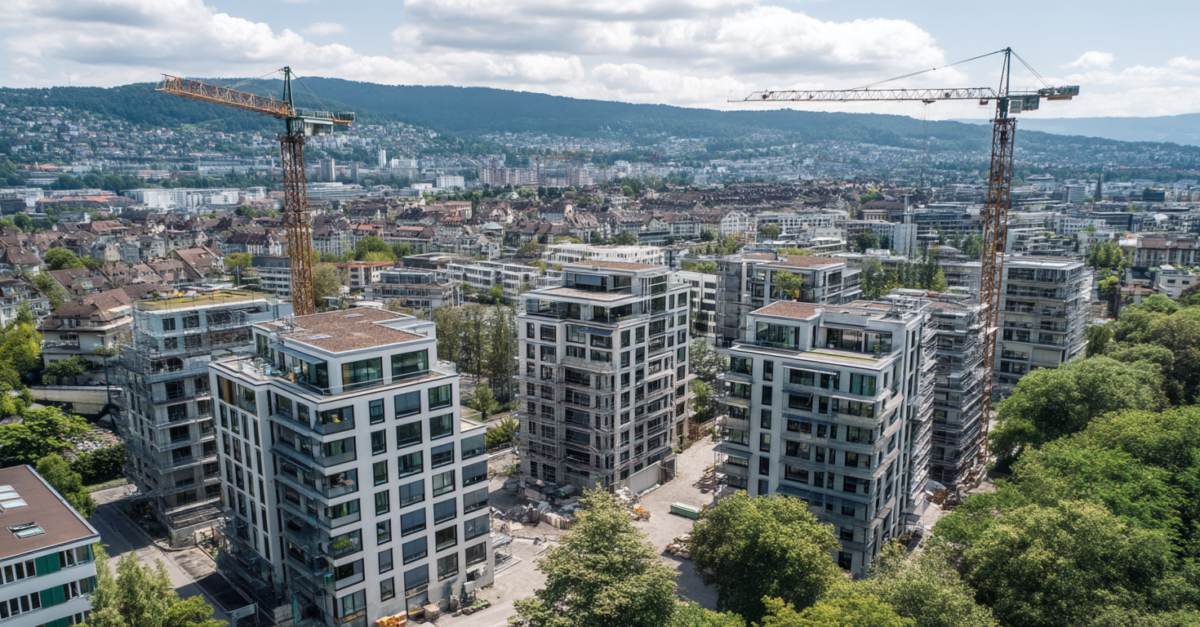
The Zurich agglomeration is the only one in Switzerland where the population is growing faster than the housing stock. This was revealed by a study conducted by the Zurich research institute Sotomo on behalf of Fürschi Züri.
The housing stock in the Lausanne conurbation has grown by 10.0 per cent since 2016, in Geneva by 8.9 per cent and even in Winterthur by 8.5 per cent. In Zurich, the figure was only 7.8 per cent. Within the Zurich agglomeration, the labour market region of Kloten saw above-average growth of 10.9 percent, Uster-Dübendorf 8.6 percent and Limmattal 8.4 percent.
The agglomeration is lagging behind, particularly in terms of new builds, with growth of 3.8 per cent. Only the Basel agglomeration is lower at 2.7 per cent. Lausanne has 5.5 per cent more new builds and Winterthur 5.3 per cent.
Zurich, on the other hand, is ahead with an increase of 4.5 per cent in replacement new builds. However, Zurich is also the agglomeration in which replacement new builds create the lowest number of new flats with a factor of 2.8 and the smallest new living space with a factor of 3.4. Even Winterthur achieves a factor of 3.4 for the number of flats and 3.7 for floor space. Lausanne leads the field with a factor of 6.5 for the number of apartments and 5.9 for floor space, followed by Geneva with 6.1 for the number of apartments and 5.6 for floor space.
There are considerable differences within the Zurich agglomeration. The labour market region of Kloten has a factor of 4.3 for the number of flats. The fewest new flats are being created in Küsnacht-Meilen with a factor of 2.2. In the city of Zurich, the factor for the number of flats is 2.3.
Young people and families are the main direct beneficiaries of new builds. The majority of residents of new builds come from the municipality (Zurich agglomeration 41 per cent, Winterthur 50 per cent) or from the agglomeration (Zurich 39 per cent, Winterthur 11 per cent). Newcomers from abroad mainly move into existing flats; in the agglomeration, they make up 23 per cent of all newcomers to existing flats.
Completely renovated flats are generally more expensive than new builds. Newly occupied existing flats in sought-after locations are just as expensive as new builds, and even more expensive in Geneva. New builds do not drive up the prices of neighbouring existing flats either.
The Zurich conurbation is dependent on new construction, concludes study author Michael Hermann. “New buildings are the key to ensuring that Zurich remains an attractive place to live for everyone,” he is quoted as saying in a press release from Fürschi Züri.
“Blocking renovations and new builds is counterproductive,” adds Raphaël Tschanz, Director of the Zurich Chamber of Commerce(ZHK). “Without new builds, young adults and families will be displaced.”
Fürschi Züri is an initiative of the ZHK and like-minded organisations and individuals.