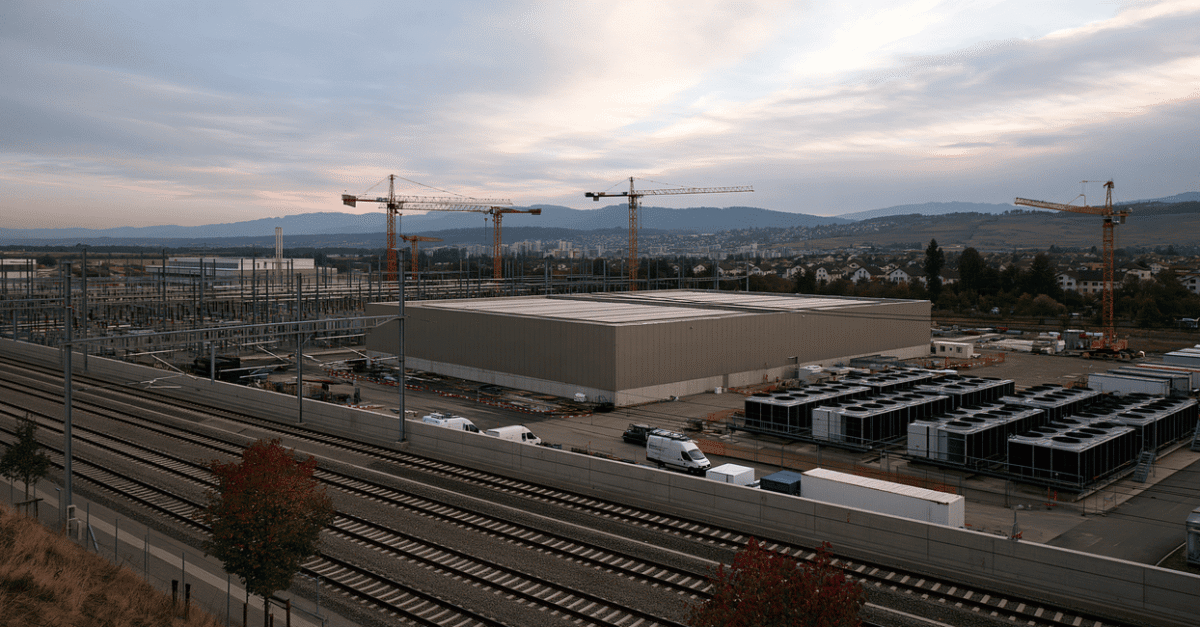

The driving factor is the sheer scale of the expansion. Financial and real estate economist Stijn Van Nieuwerburgh estimates that the U.S. expansion of data centers, power infrastructure, and specialized hardware already planned through 2032 will cost nearly 9 trillion dollars. That would amount to an average of 3.2 percent of U.S. economic output per year from 2025 to 2032.
This marks a shift in the interest rate environment that characterized Switzerland during the era of negative interest rates. Although the Swiss National Bank kept its key interest rate at 0 percent on September 24, 2026, and continues to forecast GDP growth of 1.5 to 2 percent for 2026, However, the central bank itself cites the global economy as the most significant risk factor for Switzerland’s outlook.
Capital Is Becoming Scarce Again
This mechanism is central to the real estate market. When technology companies and their suppliers channel trillions into data centers, networks, energy infrastructure, and chips in a short period of time, the global demand for capital rises. This is precisely what is eroding a core pattern of recent years, when high savings met with too few profitable investments. For Switzerland, this means increasing pressure on long-term returns and, consequently, on fixed-rate mortgages.
In his Columbia analysis, Van Nieuwerburgh describes a U.S. expansion of approximately 188 gigawatts of additional AI capacity by 2032. According to his calculations, a typical AI campus with 200 megawatts costs around $8.2 billion. Such scales make the data center boom relevant for construction, energy supply, and land markets as well—far beyond the technology sector.
Switzerland remains connected
For Saron mortgages, monetary policy is the key factor. The SNB is currently keeping its key interest rate unchanged, but as the global investment slump comes to an end, the risk is rising that Swiss financing costs will also shift upward in the longer term. At the same time, the federal government raised its economic forecast in September 2026, citing the strong first half of the year. This further weakens the case for a permanently ultra-loose monetary policy.
Real Estate Feels the Impact of the Global Market
For owners, developers, and investors, the consequence is clear. The AI boom is not a distant U.S. technology issue, but a global capital drain with a direct impact on Swiss mortgages, returns, and calculations. Even if new crises temporarily dampen the trend, the starting point is different from what it was before the launch of ChatGPT in November 2022. Massive investment is taking place again, and that is precisely what is making money more expensive.