

Lucerne railway station is one of the busiest in Switzerland, alongside Zurich and Bern. Its access infrastructure has reached its capacity limit; it is no longer possible to offer any more services. Every additional service comes up against a physical limit.
Whilst other regions have been able to significantly expand their rail services over the past few decades, Central Switzerland has been waiting for a major expansion for over 50 years.
The solution lies underground
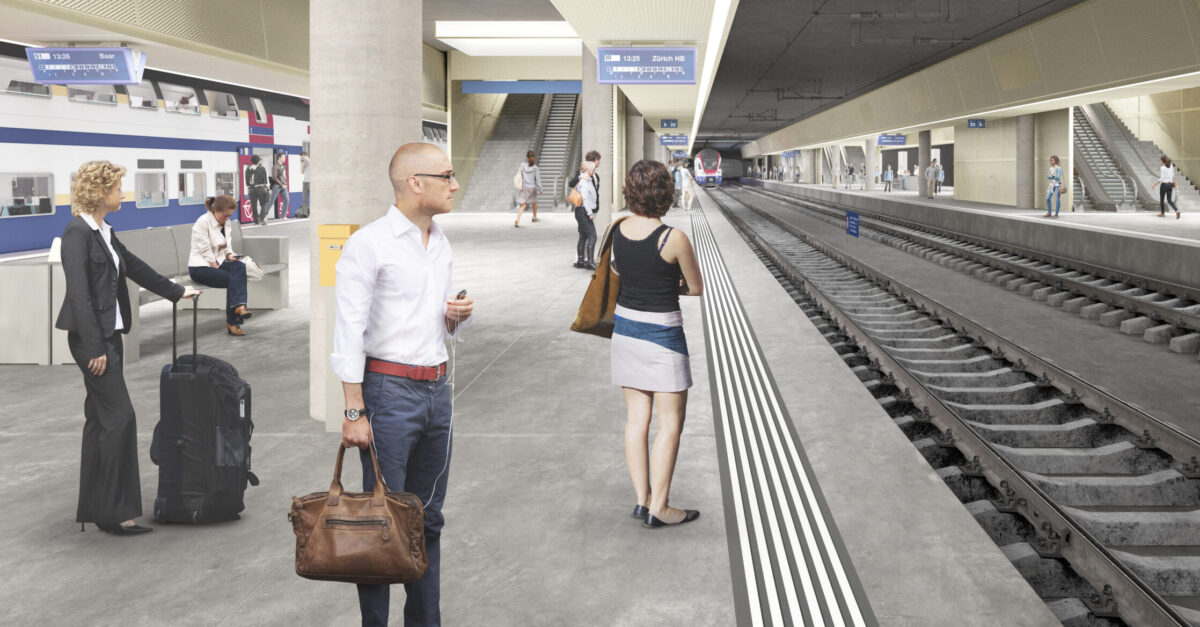
The planned through station comprises three key elements: an underground station with four tracks, a 44-metre-wide platform concourse, and the 3.8-kilometre-long Dreilinden Tunnel. This tunnel runs from Ebikon, passing beneath Lake Lucerne. The Neustadt Tunnel connects the new facility to the existing rail network.
The current terminus station would be transformed into a genuine through station. Trains would no longer need to turn round, but could pass through the station without changing direction.
More trains, new connections, shorter journey times
The Lucerne through station will transform the current terminus into a modern transport hub, enabling new, more frequent and faster connections, as well as the expansion of public transport in Lucerne and throughout Central Switzerland. The through station is the key element for a denser S-Bahn network in Central Switzerland, with an attractive quarter-hourly service on the S-Bahn and through services that further reduce journey times, as detours and changes are no longer necessary.
At the same time, journey times on the north-south axis between Basel and Milan could be reduced by up to 20 minutes. Connections via Lucerne to Ticino would also become attractive again from French-speaking Switzerland and Bern. This route would therefore be faster than the current detour via Zurich. This would benefit not only commuters but also international rail traffic through Central Switzerland.
A breakthrough for the region
Cantonal Councillor Fabian Peter describes the project as a necessary breakthrough. Without this expansion, the entire rail system risks becoming overloaded. An attractive public transport service is crucial to ensuring that the growth in mobility in the canton of Lucerne can be managed and handled sustainably.
The new station is intended to link Central Switzerland more closely with Zurich and the international rail network, thereby strengthening both the region’s position as a business hub and the daily lives of commuters.
For Councillor Peter, the expansion is therefore not a luxury but a necessity. Only in this way can the region keep pace with growth in other parts of the country. He also sees the project as a key component of the national north-south link along the Gotthard axis.
The price of the future
The federal government has set a budget of 5.1 billion Swiss francs for the entire project (the underground station as well as the Dreilinden and Neustadt tunnels). As things stand, the first phase of construction is expected to cost around 3 billion Swiss francs. The federal government has already allocated 85 million Swiss francs for the project planning. However, the actual financing of the construction is still unresolved and depends on the political will in Bern. For a country with a long tradition of infrastructure development, the project would be one of the largest single investments of the coming decades.
Between hope and caution
In 2023, a proposal from the federal government caused concern. For the first time, there was talk of phased implementation. Lucerne feared that this could result in nothing more than an additional dead-end station without a genuine through route, and that completion of the overall project would be delayed by years.
The region’s campaign in favour of the through station as a single, integrated project had an impact. The project remains on track for the time being, though the funding will be split into two phases. The debate, however, highlighted just how politically fragile major projects can be as soon as the pressure to make savings in Bern intensifies.
The decision will be made in 2027
With the ‘Transport ’45’ proposal, the Federal Parliament will decide in 2027 on the implementation of the first phase (underground station and Dreilinden Tunnel) of the project. Construction could begin in the mid-2030s at the earliest. The construction period for the first phase is expected to last between eleven and 13 years.
Until then, Lucerne station remains a symbol of the balancing act between growth and waiting. For a region that is pushing ahead and a system that cannot yet keep up. Anyone hurrying through the cramped platforms today is waiting for a promise that will not materialise for at least a decade.
Billions for the future
More Articles
Senior housing is forcing new construction and municipalities to renovate
57 percent of the population places the responsibility for independent living in old age on the state and local governments, while 44 percent places it on the real estate industry.…
 immo!nvest+
455,357 units in just under three years. Would Switzerland still be in the building permit application stage?
By the end of December 2025, Hatay had made tremendous progress in reconstruction following the 2023 earthquakes. According to Turkish authorities, 455,357 residential and commercial units were handed over in…
 immo!nvest+
Lucerne is picking up the pace on urban densification
The Lucerne Cantonal Council no longer wants to leave unused building land idle and has instructed the Cantonal Government to support the municipalities in realizing their potential for densification. The…
Zurich Continues to Push Households to the Outskirts of the Metropolitan Area
Since 2021, nearly 240,000 additional households have emerged in Switzerland, while only about 220,000 new apartments have been built. The impact of this is particularly evident in the Zurich area,…
 immo!nvest+
Swiss Ratings Combine Power and Distrust
According to the company, more than half of the Swiss market for valuing investment properties is controlled by a single provider. It is precisely this concentration that fuels criticism of…