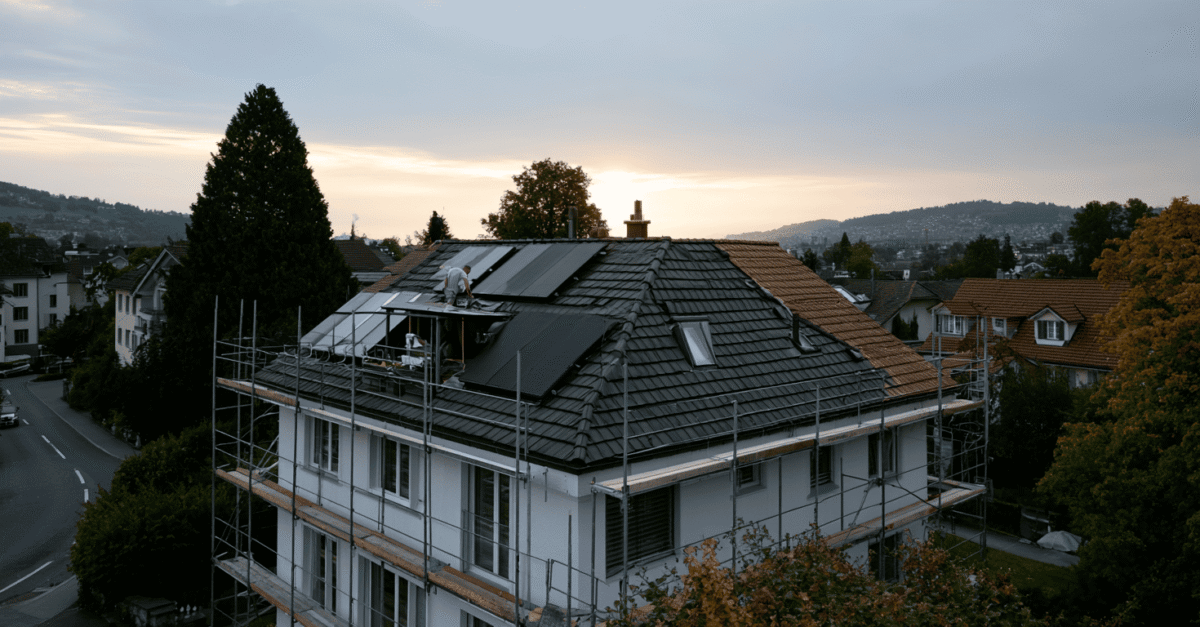

For the time being, there is no sign of a political U-turn. Although a motion tabled in the Cantonal Council calls for the obligation to generate one’s own electricity during roof renovations to be removed from the Lucerne Energy Act, the Cantonal Government is not having any of it and maintains that the timing of the renovation is particularly crucial for photovoltaic installations.
Motion M 618 was tabled on 1 December 2025. It targets Section 15 of the cantonal Energy Act, which the Cantonal Council had amended on 17 June 2024 and which has been in force since 1 March 2025. Since then, the solar obligation has applied not only to new buildings but also to existing buildings undergoing roof refurbishment, provided that work goes beyond mere repair or maintenance.
Renovations are the bone of contention
For property owners, the conflict is very real. Anyone renovating a roof must make appropriate use of its electricity-generation potential or pay a substitute levy. The proposers of the motion criticise the additional costs, administrative burden and planning interventions, particularly in the case of existing properties. In real estate practice, it is therefore not so much the solar technology itself that is controversial as the point at which investments are triggered.
The canton refers to the enforcement rules and to exceptions. Existing buildings are only affected if they are heated, ventilated, cooled or humidified. Partial roof areas are only considered usable if they are larger than 25 square metres, have space for at least six contiguous photovoltaic modules and are rated as at least ‘good’ according to Sonnendach.ch. If the minimum output is not achieved, a substitute levy of up to 1,000 Swiss francs per kilowatt not installed may be payable instead.
Government insists on expansion targets
The cantonal government justifies its hard line by citing the long service life of roofs and the expansion pathway for solar power. Anyone who opts out during renovation may not retrofit their roof for decades to come. Lucerne’s Energy Act estimates the potential for rooftop solar at around 2.4 terawatt-hours. A recent response from the cantonal government regarding the solar roof requirement already mentions a potential of 3.3 terawatt-hours. The canton is thus making it clear that, to meet its climate and energy targets, every roof that can be usefully utilised is needed.
However, the system is not entirely rigid. Systems already installed can be taken into account, and offsetting on the same plot or site is also possible. Furthermore, for existing buildings, a lower proportion of roof area need not be covered than for new builds. The cantonal government is therefore signalling some leeway in enforcement or at the regulatory level, but rejects a complete abolition of the requirement.
For those carrying out renovations, the uncertainty remains
This brings the conflict back to the point where it can prove most costly for the construction and property sectors: namely, the political process shortly after new rules come into force. For property owners, planners and contractors, it remains to be seen whether the Cantonal Council will follow the Government’s lead or revisit the requirements for roof refurbishments. It is precisely this uncertainty that affects projects where the timing of refurbishment, the investment budget and the energy concept must already be closely coordinated.