Development Switzerland Calls for Five Reforms
According to Entwicklung Schweiz, housing construction in Switzerland has reached a historically low level. Meanwhile, the population—and thus the demand for housing—continues to grow. In its position paper titled “Ways Out of the Housing Crisis,” the industry association calls for fewer obstacles, faster procedures, and a fundamentally modernized approach to land-use planning.
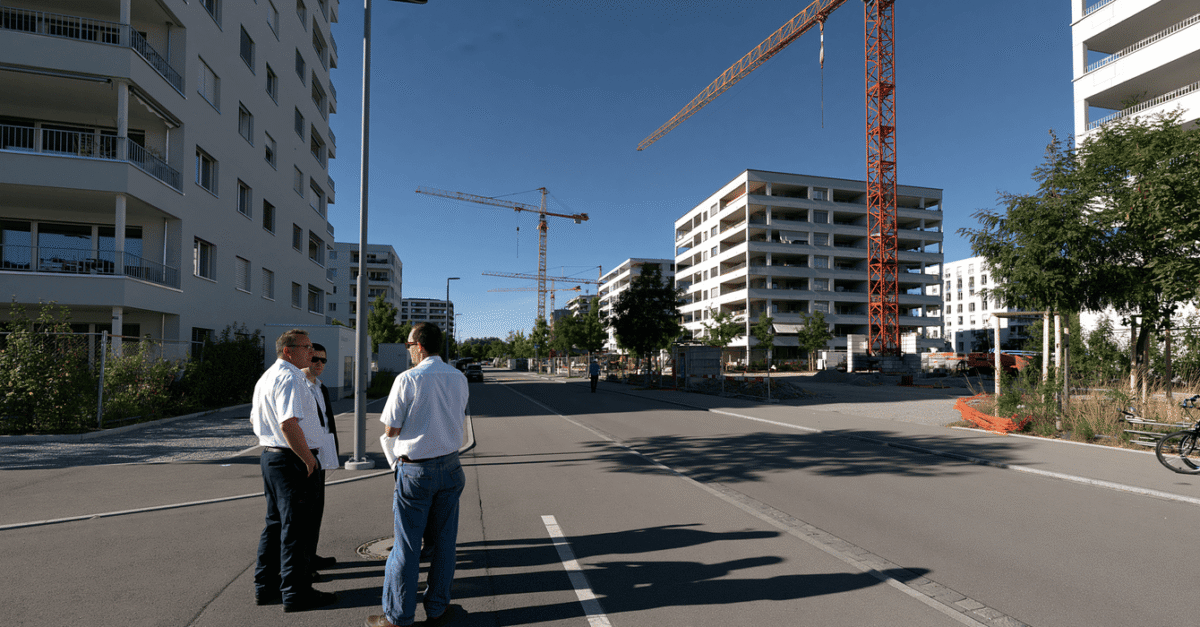
For Entwicklung Schweiz, the diagnosis is clear: housing construction is not keeping pace with demand. Construction activity has fallen below 1980 levels, even though Switzerland needs additional housing due to its strong economy and sustained population growth. The association does not view this as a temporary market phenomenon, but rather as the result of political and regulatory conditions that are making development, planning, and implementation increasingly difficult.
That is why Entwicklung Schweiz has published its policy paper on the “housing crisis.” The industry association represents companies that develop, plan, and carry out construction and real estate projects. Its appeal to policymakers, government agencies, and other stakeholders is: “Let us build.” At the heart of the paper are five reform demands designed to accelerate housing construction and, in particular, to facilitate infill development.
Give Greater Weight to Housing
First, Entwicklung Schweiz calls for “reasonably applied” historic preservation. When balancing competing interests, the public interest in sufficient housing should be given greater weight than the preservation of the local character. This demand targets conversions, renovations, replacement new construction, and densification in existing residential areas. It is precisely in these areas that projects often face a tension between preserving existing buildings and creating additional housing units.
Second, the association wants to link the right to object more closely to direct impact on the applicant. Abusive objections should be effectively sanctioned. From the industry’s perspective, appeals and objections often lead to delays, high planning costs, and uncertainty. Critics of such a restriction, on the other hand, are likely to point to the importance of legal protection, democratic participation, and the protection of public interests.
On Spatial Planning and Redevelopment
The third demand concerns the Spatial Planning Act. Entwicklung Schweiz advocates for re-zoning to allow new developments in areas with good transportation access, while at the same time re-zoning out peripheral areas. In addition, the strict separation of land-use zones should be broken down. In doing so, the association builds on its earlier positions: infill development, mixed-use development, and the development of rail station areas should be made easier than new construction in poorly accessible locations.
Fourth, the paper proposes a renovation initiative. The renovation rate should be increased from the current level of about one percent to three percent. As an incentive, Entwicklung Schweiz calls for at least 30 percent of additional floor area to be credited toward building codes in renovation projects. The idea combines two goals: existing buildings should be retrofitted for energy efficiency, while at the same time creating additional living space. Whether such a floor area bonus will actually trigger investments on the desired scale, however, depends on municipal building codes, land and construction costs, and the respective permitting conditions.
Moving Away from the Planning Marathon
Fifth, Entwicklung Schweiz calls for streamlined procedures. Binding deadlines and a more direct path from land-use planning to building permits are intended to shorten the so-called “planning marathon.” In the association’s view, what is needed are not only new political goals but also processes that make it possible to complete projects within a reasonable timeframe.
The position paper adds a supply-side perspective to the current debate on affordable housing. While cities like Zurich and Lausanne are purchasing properties or seeking to transfer housing to the nonprofit sector through preemptive purchase rights, and Mobiliar is providing equity capital for rent-controlled housing, Entwicklung Schweiz is focusing on the rules. The association aims to change the conditions under which construction, renovation, densification, and redevelopment can take place.
These demands are not without political controversy. They concern the protection of historic buildings, the right to object, urban development, and the role of municipalities. Precisely for this reason, the paper is more than just an industry appeal: It articulates a central question in the housing debate—whether Switzerland intends to address its housing shortage primarily through additional capital and public commitment, or equally through faster and more flexible planning regulations.