A Building for the Almost Invisible
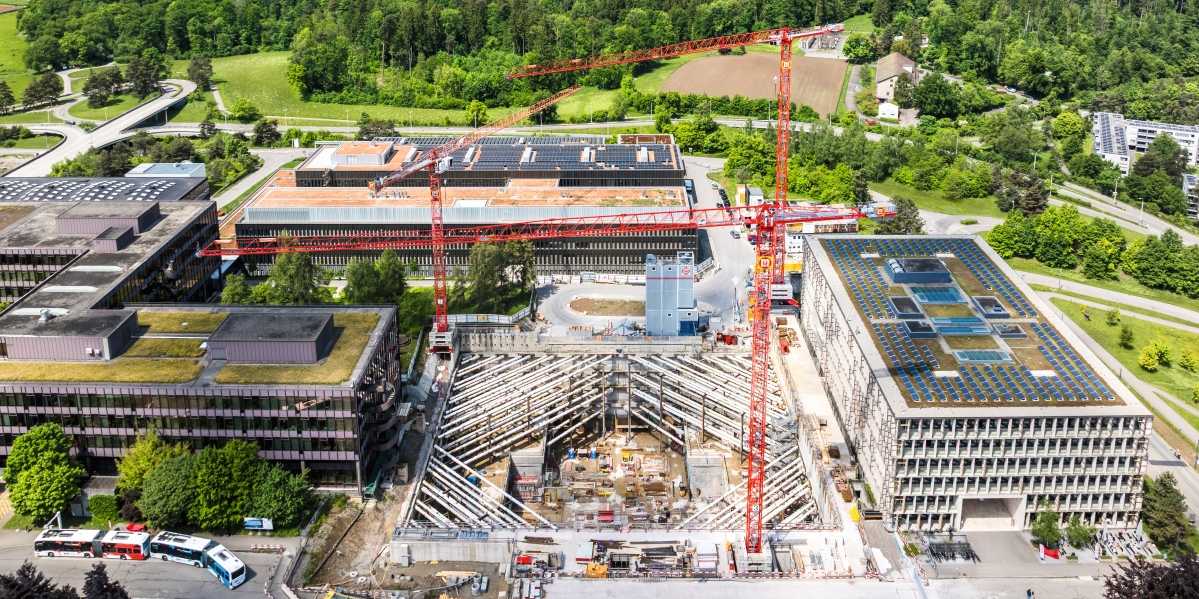
ETH Zurich isn’t just building a new physics building on the Hönggerberg. It’s constructing a controlled environment deep underground. The HPQ is designed to enable high-precision research in which even the slightest vibrations, magnetic fields, or temperature fluctuations can skew measurements. Starting in 2030, around 500 researchers and staff are expected to work here at the limits of what is measurable.
© Alessandro Della Bella / ETH Zurich
The HPQ is being built between the existing ETH buildings HIT and HIL. One-third of the facility is above ground, and two-thirds are underground. The particularly sensitive laboratory area extends up to 28 meters below ground. This is where the Center for Low Noise Experiments is being built. Research equipment rests on concrete bases weighing up to 120 metric tons. Active air springs isolate them from the rest of the building. The laboratories must maintain temperature fluctuations of no more than 0.01 degrees Celsius and vibrations of no more than 0.1 micrometers per second.
The Building Adapts to Science
The initial ideas for the HPQ emerged in 2010. The existing physics buildings from the 1960s no longer met the requirements of new research. Unlike many construction projects, therefore, the process did not begin with the architecture but with a scientific requirements profile.
Professors, internal specialists, and external experts developed a concept for this purpose. The team visited leading research infrastructures in the U.S., the U.K., and Germany. It also examined existing ETH buildings to determine how sensitive various research groups are to temperature, vibrations, and other environmental factors.
Modular for the Unknown
This preparatory work led to a modular spatial concept. In the future, laboratories can be combined or adapted to new research requirements. Standardized technology is intended to create synergies and simplify future maintenance.
Approximately 25 professors from the Department of Physics, as well as researchers from other departments, are expected to use the building. The plan calls for about 8,000 square meters of laboratory space and 4,000 square meters of office space. Research will focus on new materials, computer chips, and components for quantum computers controlled by individual photons.
Architecture with Precision
Ilg Santer Architects from Zurich won the competition in 2016. Construction has been underway since 2022. The building comprises four above-ground floors of laboratories and offices, a public two-story ground floor, and a technical floor on the roof.
This complex task requires collaboration across numerous disciplines. Experts in laboratory construction, structural engineering, building services, and architecture first had to understand how physicists actually work. Before planning began, ETH Zurich therefore organized joint tours of existing laboratories and direct discussions with the research groups.
An Infrastructure for Decades
Construction progress is visible. By June 2026, work had reached the second basement level; by the end of the year, the structural framework for the first above-ground floors is scheduled to be completed. Occupancy is planned for 2030. The HPQ is no ordinary university building. It is a research infrastructure that organizes precision spatially. If, in the future, even the slightest tremor is absent in its depths, this could give rise to knowledge that advances quantum research, new materials, and the technologies of tomorrow.