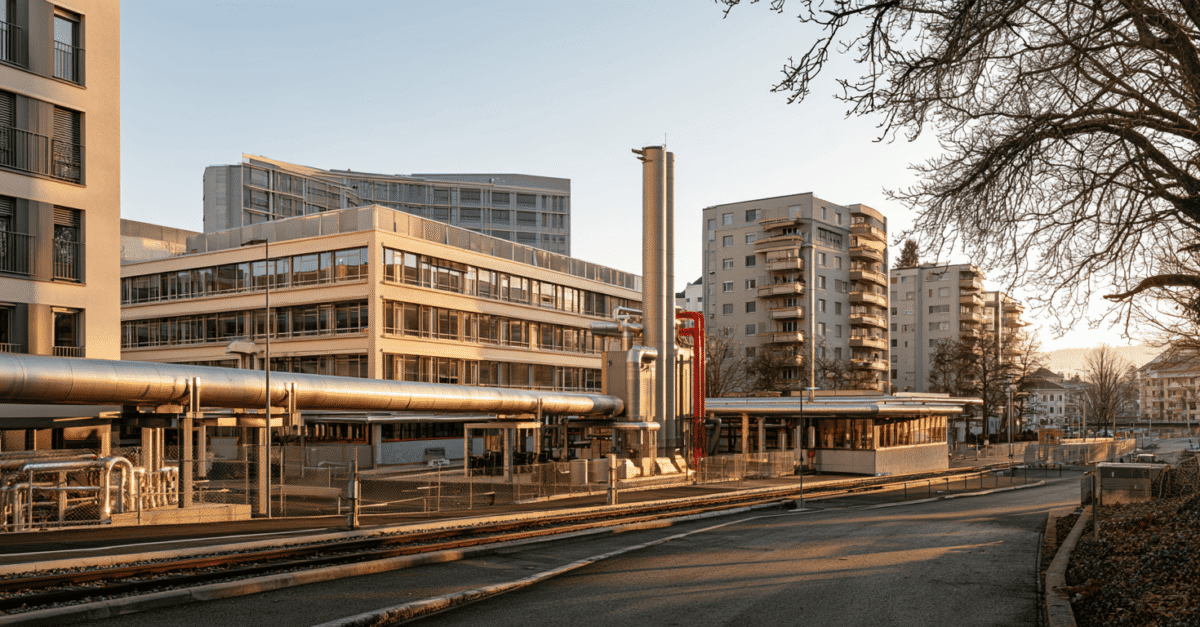

This new phase builds on the strategy set out in December 2024. At that time, the city secured approval for the first 20 connection contracts. This is now followed by a further tranche, which is intended to see just under half of the target achieved by 2028: connecting a total of around 60 municipal buildings to district heating networks by 2040.
The properties now included in the plan are the Jurintra nursery school, the municipal library, the new Champagne school building, the property at Mattenstrasse 133, and blocks of flats at Mühlestrasse 45 and Sägefeldweg 49. Depending on the building, energy supply is set to begin between 2028 and 2036. For the Champagne school building, a cooling supply contract is also planned for the first time.
Some costs to be borne by the City Council
The one-off connection costs range from 20,000 to 100,000 Swiss francs per building. The annual base charges range from around 4,000 to 90,000 Swiss francs. As the recurring costs for the Champagne school building and the property at Mattenstrasse 133 are higher, the City Council must approve these two contracts at its meeting on 16 and 17 December 2026. The Municipal Council has already decided on the remaining contracts.
The one-off connection cost contributions, totalling just over 350,000 Swiss francs, will be paid from the special fund for climate protection and climate adaptation. In the case of the Champagne school building, the connection costs were already included in the building loan, which Biel’s voters approved on 9 June 2024. The ongoing operating costs will be borne by the respective building users.
Decarbonisation becomes a portfolio requirement
For the city, connection to district heating networks is a key tool for making the administration climate-neutral by 2040. In practical terms, this means that fossil-fuel heating systems will be phased out and operating models will be aligned earlier with long-term energy contracts. The current tranche therefore links climate targets directly to investment decisions, building operations and new-build planning.
The timeframe creates additional pressure. Whilst some of the heat supply contracts now agreed will begin as early as 2028, individual connections will not come on stream until 2036. For owners of large public properties in particular, Biel is thus demonstrating that decarbonisation cannot be achieved through a single project, but must be coordinated contractually, financially and technically over a period of years.